
Inter-Entity Purchase Orders and Sales Orders in ERP Systems
By John Nugent
For manufacturers operating across multiple legal entities, plants, or business units, managing intercompany transactions efficiently is essential. When one entity needs to buy from another, disconnected processes and manual workarounds can create delays, errors, and accounting headaches.
That is where inter-entity purchase orders and sales orders come in. Visibility supports multi-entity and inter-entity processing, giving manufacturers a structured and automated way to manage transactions between related companies inside a single ERP environment. Instead of relying on spreadsheets, emails, or duplicate data entry, teams can create a more connected process for internal purchasing, fulfillment, and financial visibility.
What Are Inter-Entity Purchase Orders and Sales Orders?
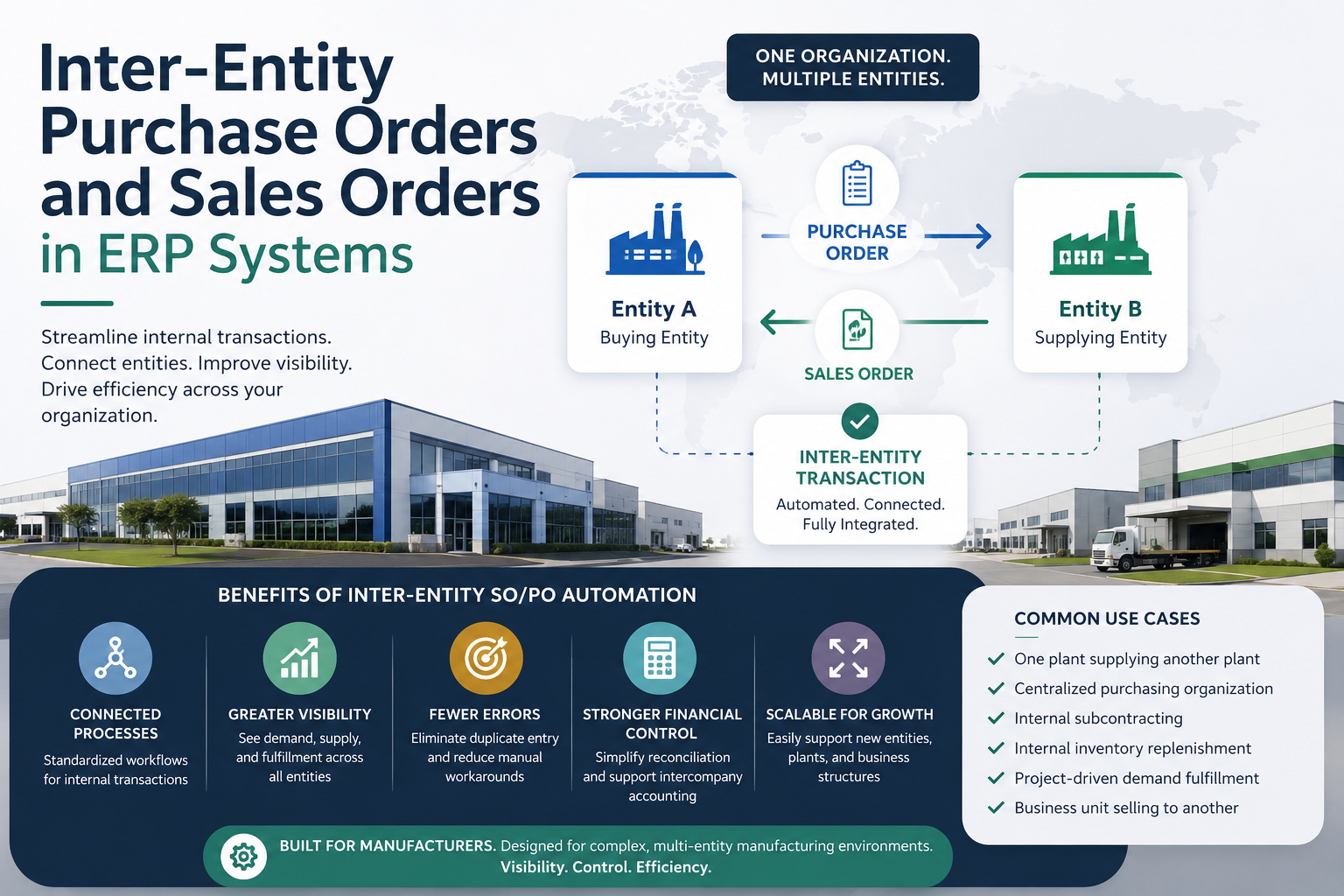
Inter-entity purchase orders and sales orders allow one company within an organization to transact with another company in the same ERP system. For example, an organization may have multiple manufacturing entities in different geographies and be able to fulfill demand and cut costs and cycle time by manufacturing in a different entity than the order receipt entity. When the buying entity needs inventory, components, or finished goods from the supplying entity, Visibility can support that internal transaction using automated sales order and purchase order processes. This gives organizations a consistent framework for:
- Managing internal supply relationships
- Improving transaction traceability
- Reducing manual rekeying
- Wupporting intercompany accounting and settlement
- Creating cleaner audit trails across entities
Why Multi-Entity Manufacturers Need a Better Intercompany Process
Manufacturers with complex structures often deal with shared inventory, shared production resources, centralized purchasing, or internal subcontracting between entities. Without an ERP-driven intercompany workflow, common problems include:
- Duplicate order entry
- Inconsistent pricing between entities
- Poor visibility into internal demand
- Slow approvals
- Reconciliation issues between companies
- Difficulty tracking internal fulfillment activity
Visibility helps address these challenges by supporting inter-entity purchase order and sales order workflows within a broader multi-entity ERP framework.
How Inter-Entity Processing Works (in Visibility)
Inter-entity processing involves:
1. Defining the entities
Each legal entity is established within the ERP structure, with its own operational and financial context.
2. Setting up internal customer and supplier relationships
Entities can be configured to act as the supplier to another. These entities/trading partners are tagged as inter-entity trading partners via a simple configuration.
3. Configuring inter-entity controls
Organizations can set the rules that govern how intercompany orders are created, processed, and settled.
4. Creating linked purchasing and sales transactions
When one entity purchases from another, the transaction can follow an internal PO/SO process instead of an external vendor/customer process. There are automated processes within Visibility to create purchase orders and sales orders for inter-entity transactions. This is a huge time saver and efficiency gain for a multi-entity organization.
5. Managing settlement and accounting
Intercompany payment methods, purchasing entity information, and related controls support the financial side of the transaction.
Business Benefits of Inter-Entity SO/PO Automation
When intercompany transactions are managed inside Visibility, manufacturers can gain meaningful operational and financial benefits.
Better internal supply chain coordination and automation
Teams can move material, components, or finished goods between entities using standardized order workflows instead of informal requests or manual purchase orders and sales orders.
Fewer manual errors
Eliminating duplicate entry reduces the risk of mismatched quantities, pricing issues, and missed transactions.
Stronger financial control
Intercompany activity is easier to track, support, and reconcile when it runs through defined ERP processes.
Improved visibility across the organization
Leaders can see how entities are supporting one another and where internal demand is originating.
Scalable support for growth
As organizations expand into new plants, divisions, or legal entities, Visibility provides a stronger foundation for structured intercompany operations.
Ideal Use Cases for Inter-Entity Processing in Visibility
Manufacturers often use inter-entity purchase orders and sales orders when they need to support scenarios such as:
- One plant supplying another plant
- One plant fulfilling demand for an order made to another plant (can also drop ship between entities for efficiency and cost savings)
- One entity acting as a centralized purchasing organization
- One business unit selling to another internal operation
- Internal subcontract or outside processing between entities
- Project-driven demand fulfilled by a related company
- Internal inventory replenishment across business structures
Supporting Complex Manufacturing Environments
Visibility is designed for manufacturers with sophisticated operational requirements. That makes inter-entity functionality especially valuable for companies dealing with:
- Engineer-to-order environments
- Make-to-order production
- Multi-site manufacturing
- Shared services organizations
- Internal supply chain dependencies
- Complex costing and accounting structures
Rather than treating inter-company transactions as exceptions, Visibility helps make them part of a controlled, repeatable process.
