
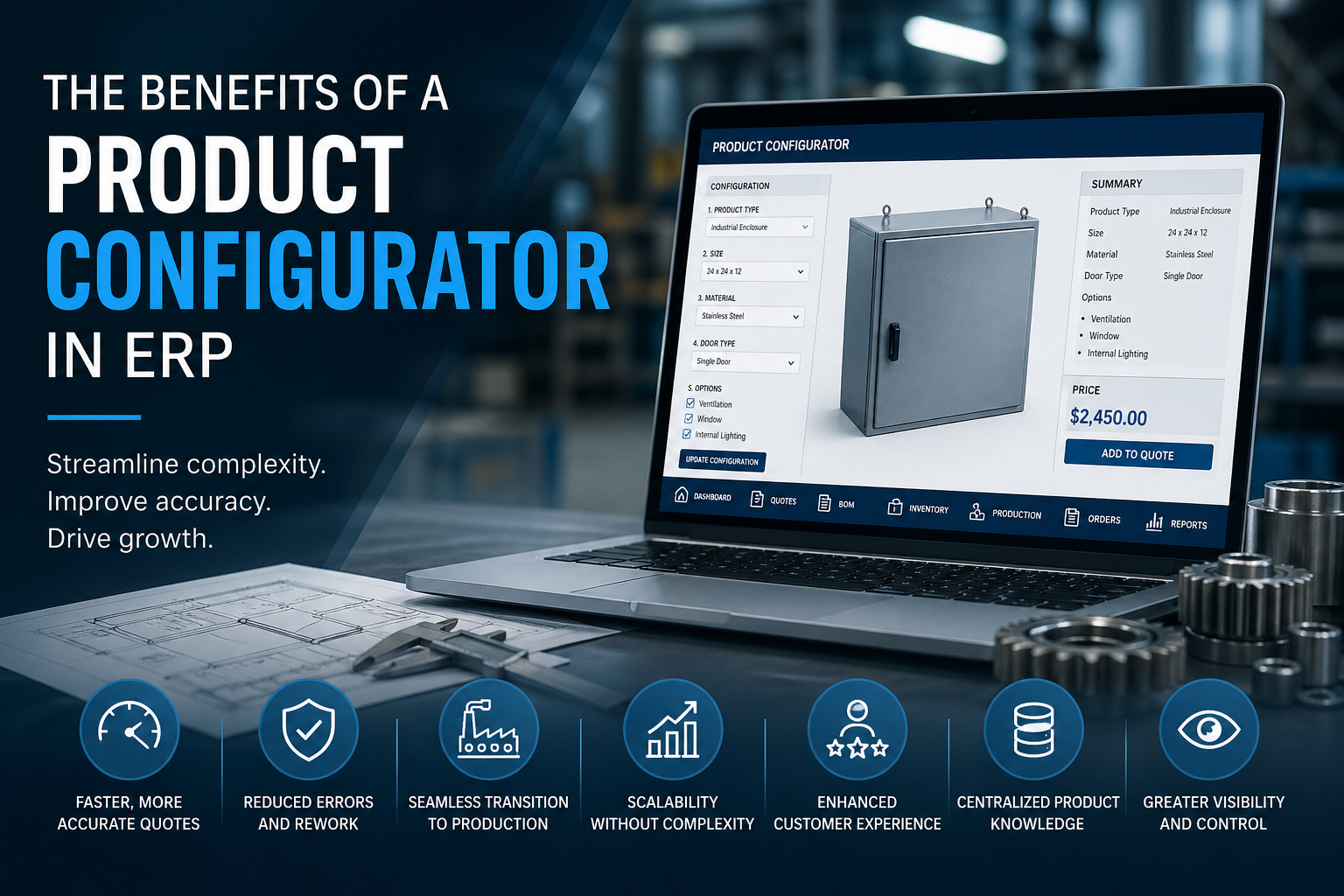
The Benefits of a Product Configurator in ERP for Manufacturers
By Mike Murphy
A product configurator within an ERP system may sound like a niche feature—but for manufacturers producing complex, customizable products, it can transform operations, improve accuracy, and accelerate growth.
Here’s why it matters.
The Challenge of Product Complexity in Manufacturing
Modern manufacturers rarely offer one-size-fits-all products. Instead, they manage countless variations—dimensions, materials, features, and customer-specific options.
Without the right tools, this complexity is often handled through spreadsheets, emails, or tribal knowledge—leading to:
- Delays in quote generation
- Heavy reliance on engineering for validation
- Order errors and inconsistencies
- Incomplete or unclear production instructions
A product configurator in ERP solves these challenges by centralizing product rules and making them accessible across sales, engineering, and production teams.
What Is a Product Configurator in ERP?
A product configurator is a rules-based system that enables users to build valid product combinations automatically.
When integrated within an ERP system, it connects directly to:
- Pricing
- Bills of Materials (BOMs)
- Inventory
- Production workflows
- Order management
This integration ensures that once a product is configured, every downstream process—from quoting to production—is accurate and aligned.
Key Benefits of a Product Configurator
1. Faster, More Accurate Quotes
Sales teams can configure products in real time—without waiting on engineering.
- Built-in rules ensure only valid configurations
- Pricing updates automatically
- Quotes are generated quickly and accurately
👉 Faster response times increase win rates and improve customer satisfaction.
2. Reduced Errors Across the Organization
Manual processes often result in:
- Incorrect specifications
- Missing components
- Pricing inconsistencies
A configurator enforces rules at the point of entry, preventing errors before they reach production.
Result:
- Less rework
- Fewer production issues
- Greater operational consistency
3. Seamless Transition from Sales to Production
Miscommunication between sales and manufacturing is a common bottleneck.
With an ERP-integrated configurator:
- Configurations automatically generate accurate BOMs
- Routings and production steps are predefined
- Engineering doesn’t need to reinterpret orders
This creates a true quote-to-production workflow.
4. Scalability Without Added Complexity
As product lines grow, manual processes break down.
A configurator enables manufacturers to:
- Handle more orders without increasing headcount
- Launch new product variations quickly
- Support less-experienced staff with guided configuration
It captures expert knowledge and makes it scalable.
5. Improved Customer Experience
Today’s customers expect fast, accurate responses—especially for custom products.
With a configurator:
- Quotes are delivered instantly
- Lead times are more predictable
- Customization becomes easier to manage
👉 This builds trust and strengthens customer relationships.
6. Centralized Product Knowledge
Critical knowledge is no longer siloed.
Instead, it’s embedded within your ERP system:
- Faster onboarding for new employees
- Consistent decision-making
- Reduced reliance on key individuals
The configurator becomes a single source of truth.
7. Greater Visibility and Control
Managing configurations within ERP provides:
- Real-time visibility into orders
- Consistent pricing governance
- Better product and profitability analysis
This supports smarter, data-driven decision-making.
Why ERP Integration Matters
A standalone configurator can help—but it creates gaps.
An ERP-integrated product configurator ensures:
- No duplicate data entry
- Alignment between quoting, engineering, and production
- Full traceability from quote to delivery
It transforms configuration into a core operational capability, not a disconnected tool.
Final Thoughts
A product configurator in ERP does more than simplify product selection—it connects your entire manufacturing process.
By aligning sales, engineering, and production, manufacturers can:
- Reduce errors
- Increase efficiency
- Scale operations with confidence
For companies managing complex, configurable products, it’s a critical tool for staying competitive in today’s manufacturing landscape.
Ready to see how a product configurator can transform your operations? Contact the team at Visibility to learn more here.
